Archives For November 30, 1999

I don’t know about yours, but my kids aren’t perfect. They are, after all, a mixture of me and their dad, who both possess several flaws of our own.

They all play sports. My husband and I love to watch them play, but up until this past year, I didn’t really tell them how much nearly enough.

You know what I have told them? I let them know that I thought they should have caught a pop fly or stopped a line drive. I told them how many more rebounds they could have had if they would’ve properly boxed out their opponents. I asked them time and time again what is your position in football technically called? (seriously, a half dozen years have passed by with me watching them, and I am still clueless when it comes to understanding the sport I never played)

Look, statistically speaking, the chances of your kids or my kids playing sports beyond high school are not high. Just read the information put out by the NCAA if you don’t believe me.

However, if you want to try and help your child enjoy their sport as long as possible (maybe your little super star does have what it takes to play on a high school varsity or collegiate team), here’s some solid advice for you…

For over three decades, Rob Miller and Bruce E. Brown of Proactive Coaching LLC studied and interviewed college athletes – specifically, what (in the athletes’ own words) happened to them growing up that had negative repercussions on their sporting careers versus, conversely, what built them up on their paths to success.

Student-athletes overwhelmingly answered that the most negative response from their parents took place on the car ride home, when the youth were trapped in the same space as their well-intentioned parents offering ill-timed advice to them after the competition was done.

What was the single best thing these athletes reported hearing over and over again from their parents? Six simple, yet powerful, words: I LOVE TO WATCH YOU PLAY.

If you are like I am and sometimes need a reminder to control your own overly competitive spirit (especially following games) consider picking up a new product on GiveTheGameBack.com called the “Steering Perspective” wheel reminder. You can affix this velcro, soft fabric signage around your steering wheel as a visual cue to enjoy the car ride home…or at least control your urge to correct your young athlete on each and everything they did wrong.
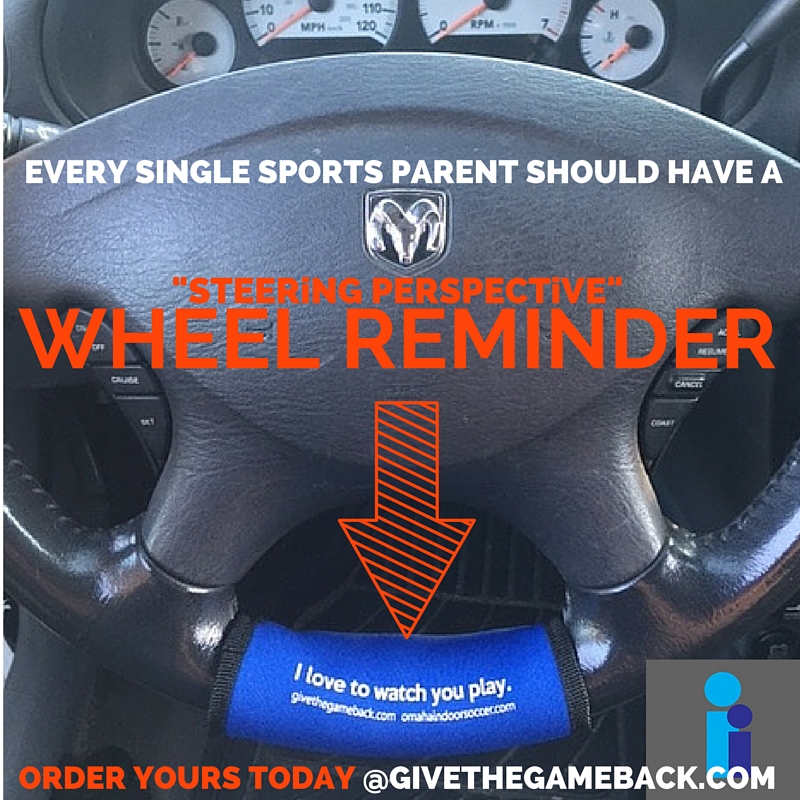
Order your "Steering Perspective" wheel reminder today for you or someone you love. Twenty five percent of all proceeds from now through December 31, 2015 will go to All Play Sports Complex.

Order your “Steering Perspective” wheel reminder today for you or someone you love. Twenty five percent of all proceeds from now through December 31, 2015 will go to All Play Sports Complex.

steering perspective flat

***Twenty-five percent of all proceeds from the sales of this product from now through December 31, 2015 will go to All Play Sports Complex. Read this article to get more information about this fabulous organization in Omaha, NE, that provides barrier free access to sports and other recreational activities for people with physical or mental disabilities.

This video is pretty cool too.

Written by Heidi Woodard

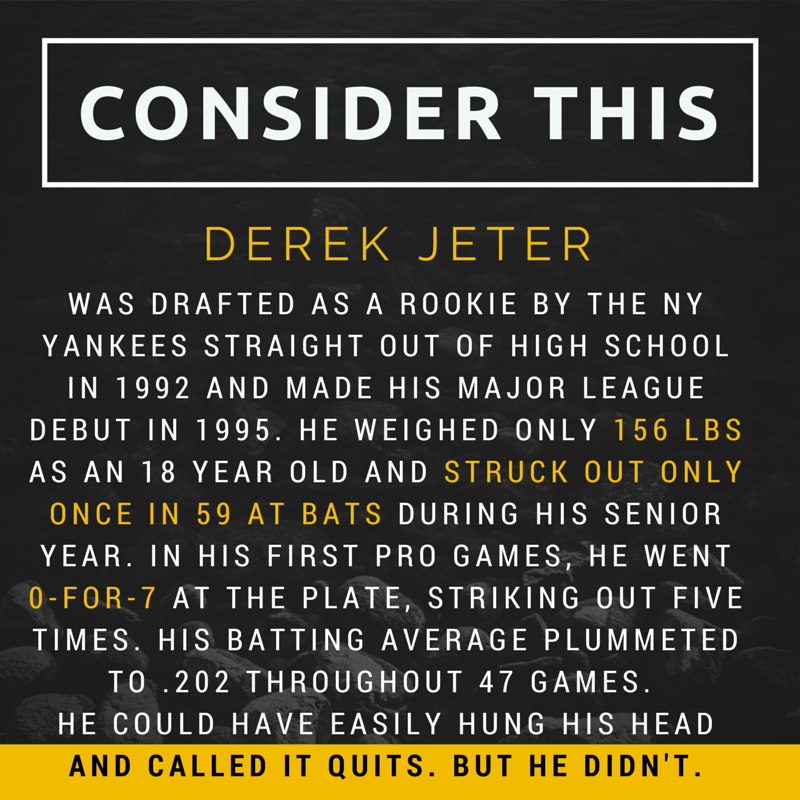
Derek Jeter

An upfront disclaimer: I am by no means a Yankees fan. Never have followed them that closely. And, yes, I realize their organization spends more money than the Kardashians. But if you’re a fan of baseball in general, it’s hard to turn a deaf ear to names like Babe Ruth, Lou Gehrig, Yogi Berra, Joe DiMaggio, Mickey Mantle, and Mariano Rivera. They demand respect for what they’ve meant to the game.

Read that graphic above again. Many people in my generation (but not my husband, DEFINITELY not him) would argue that Derek Jeter was, quite possibly, the best on the diamond.

I find it amazing and inspiring that a scrawny kid from Kalamazoo, Michigan, not only made his way to the Big Leagues, but also earned the spot of starting shortstop for the NY Yankees for 20 seasons.

According to The Life You Imagine: Life Lessons for Achieving Your Dreams, Derek grew up competing on teams that played on average a couple dozen games per year. The pitchers he faced in high school maxed out on fast balls clocking in at 85 MPH. His adjustment to the Big Leagues, subsequently, was understandably rocky at first.

Yet he learned how to set personal goals early in life (age 8 to be exact). And he was determined to reach them despite any odds stacked against him.

As I’m spreading the word about my movement to GiveTheGameBack to youth athletes in my community and beyond, I am reminded that persistence and allies fuel my determination to make a difference. Setbacks are just that…in sports and in life. They are not insurmountable unless you allow them to be.

Since January, I’ve met amazing people whom I otherwise would have never met. I’ve shared my own stories as well as those from the coaching community, my fellow parents in the stands, and even players themselves about what can be done to improve the state of youth athletics. I’ve even transformed those people who rally against fandumb into walking billboards by having them wear GiveTheGameBack t-shirts.

I want to personally thank everyone who has helped on this journey to get out of the way and let the kids play. I don’t see an immediate finish line in sight and believe it will be quite some time before we reverse some of the more disturbing trends of parental over-involvement (visit your local ball park or gym this weekend if you don’t believe me), but we’re at least taking strides in the right direction.

We can easily hang our heads and call  it quits. But we won’t.

For the record, we’re Atlanta Braves fans here in the Woodard household and I’d argue that Chipper Jones in as close to perfection as they come. 🙂

Written by Heidi Woodard

Shop page image

Let’s all gather round. I’m talking to you, parents of children who compete in sports.

I don’t know if it’s the same in your household, but my family is currently in a sweet spot known as the “off season,” when the only thing on our plates is weekly practice in preparation for summer baseball. My kids are actually adhering to a real bedtime routine. My husband and I have sat across from one another at our own dining room table and had a conversation while enjoying dinner together. I’ve both watched my DVR’d shows and napped unapologetically. It’s been surreal.

My shoulders are a little less tense. My speed is a bit slower. My breaths are much deeper.

Yet part of me misses the frenzy. The dirt and sunflower seeds are calling.

There’s a reason why the beginning of every sports season is exciting. Everyone starts with a 0-0 record and a pretty good attitude.

I’m here to tell you…the joy does not have to rise or fall in direct correlation with your kid’s success or lack there of. You can control your outlook in spite of external influences.

Perhaps you’ve heard about the study performed by Rob Miller and Bruce E. Brown, who run a coaching consultation business called Proactive Coaching LLC? For three decades, Miller and Brown asked college athletes about their parents’ behaviors; specifically, what their parents did right versus what their parents did wrong in an effort to support their budding stars?

The athletes overwhelmingly responded that the feedback that resonated the most positively with them consisted of six, simple, yet incredibly powerful words:

Top athletes reported that the most uplifting phrase they heard their parents tell them time and time again was ‘I love to watch you play.’

The worst thing that parents did, in the opinion of their kids, was critiquing or questioning them immediately following the game or competition.

So, to me, the easiest way to ensure I (and you) continue to feel positive as our budding athletes transition from the practice season to the actual season is by reminding them how much we love to watch them play. And that phrase should be the honest to goodness truth when it comes out of our mouths, regardless of the game outcome.

If we don’t mean it, then why invest the time, money, effort, and – most importantly – our children’s emotional well being by having them pursue sports?

I no longer routinely ask my kids if they had fun at the end of every game. Losing doesn’t feel fun. I don’t expect to see them muster up a smile after every final out.

But I also want them to know how to to recovery gracefully from setbacks, to not hang their heads, and to get back up when they’ve fallen.

As parents, we need to be able to hold ourselves to the same level of accountability.

Because, in the end, we must remember how much we not only love to watch them succeed, but how much we love to watch our children play. They need to be allowed to do the latter before they are ever capable of doing the former.

Written by Heidi Woodard